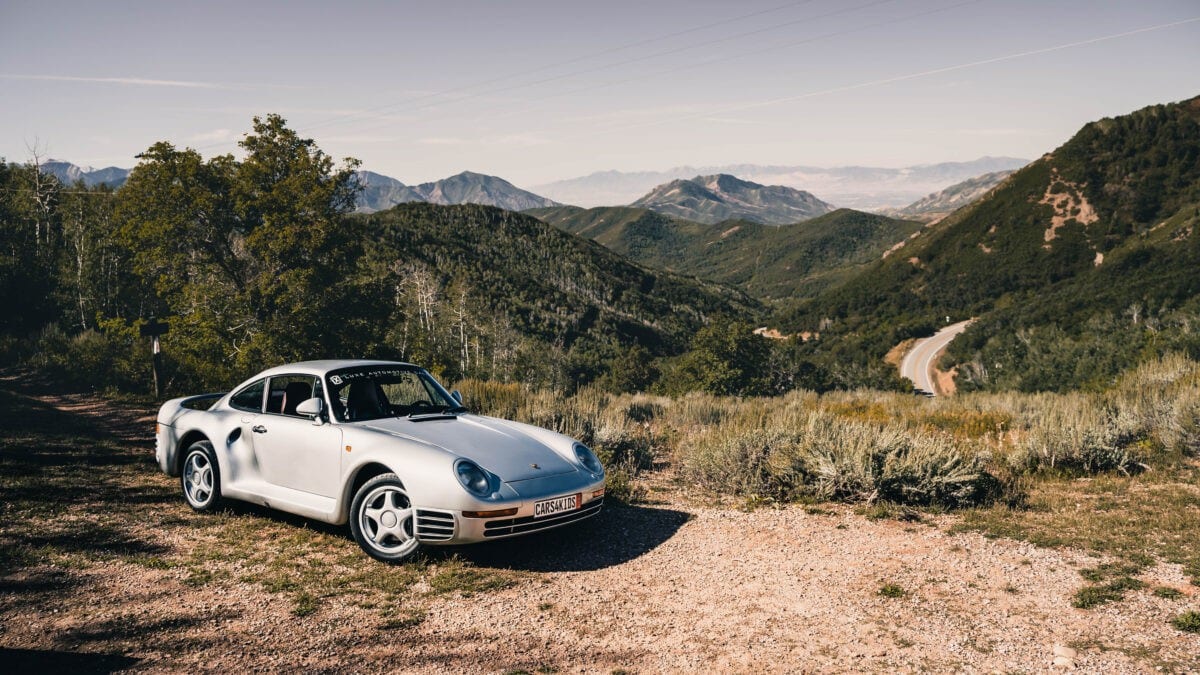
When we caught wind that Seen Through Glass, a well known vlogger, was traveling the U.S. and coming through Park City, we decided to reach out. We had a Porsche 959 staged in our showroom at LUXE Automotive at the time and thought he might like to check it out.
Why the 959 matters
Porsche built the 959 from 1986 to 1993, first as a Group B rally car and then as a road car, to meet a homologation rule that called for at least 200 to be made. When it was introduced it was the fastest street legal production car in the world, with a top speed of 197 mph.
It was one of the first high performance sports cars with all wheel drive, and it became the basis for Porsche's first all wheel drive 911, the Carrera 4. The engine is a sequential twin turbo flat six of 2.8 liters, with air cooled cylinders and water cooled heads, making 450 PS (444 hp). To keep the shell light, Porsche used aluminium and Aramid composite panels over a Nomex floor.
- Built
- 1986 to 1993
- Engine
- 2.8L twin turbo flat six
- Power
- 450 PS (444 hp)
- Drive
- All wheel drive
- Gearbox
- Six speed manual
- Top speed
- 197 mph
Car and Driver measured 0 to 60 mph in 3.6 seconds, nine tenths quicker than any other car the magazine tested in the 1980s. The first gear on the manual gearbox is labeled G, for gelände, or terrain.
Getting a 959 into America
Built for Group B
The 959 began as a rally project. Porsche development cars, modified 911s carrying an early version of the all wheel drive system and known internally as the 953, entered the 1984 Paris Dakar Rally and won it with René Metge driving. By the time the 959 was ready for production and homologation in 1987, Group B had been cancelled a year earlier, so the road car outlived the series it was built for.
Road cars came in two trims, Komfort and Sport. Customer deliveries began in 1987 and the main run ended in 1988 with 292 cars. Each sold for DM 431,550, still less than half of what it cost Porsche to build. A 959 S, a Sport with larger turbochargers, made 515 PS and reached 211 mph at Nardò in 1988.
In 1992 and 1993 Porsche assembled eight more from spare parts, all Komfort versions, four red and four silver. Those eight are the most sought after 959s today.
For years a 959 could not be legally imported into the United States. Microsoft founder Bill Gates bought one in 1988, and it sat in storage with U.S. Customs for 13 years. Owners including Gates, Otis Chandler and Bruce Canepa pushed for a way in, and the result was the Show or Display law of 1999, which allows certain rare cars that were never certified for U.S. sale to be imported. In 2003 Canepa Design began an upgrade program for the turbochargers, exhaust and engine electronics that let a 959 pass emissions and become street legal in the U.S.
A Friday morning with Sam
It was a fun Friday morning chatting with Sam about his adventures so far and about our 959. Inside, it is classic Porsche of the era, with round gauges set in a row ahead of the driver.
Check out his video.